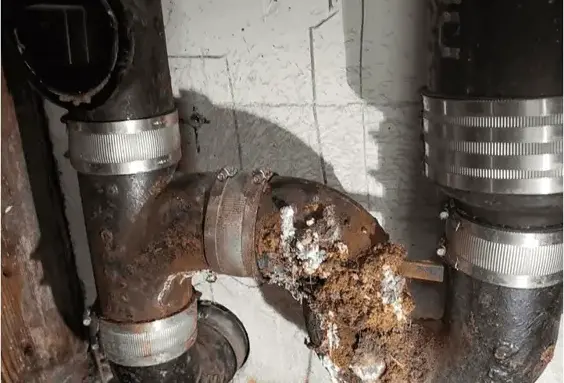
Much of Valley Stream was built out between the 1920s and the 1950s, and the drain stack hidden in the wall of those colonials, capes and Tudors is often original. When that pipe rusts through or cracks, the leak is slow, dirty and easy to miss.
Key takeaways
- Cast iron drain stacks in village homes built from the 1920s to the 1950s can rust through or crack, and the leak is usually inside a wall or ceiling.
- A stack leak carries drain water, so the stained cavity is treated as contaminated, not as a simple plumbing drip.
- Brown staining, a sewer smell near a bathroom wall and a damp basement ceiling below a bath are the early signs.
- Stop using the fixtures on that stack until a plumber has looked at it, and photograph the stain before anything is opened.
- The wall is opened only as far as moisture readings say, then the cavity is dried and the area is checked again.
Why older village homes have this problem
Valley Stream grew around the Long Island Rail Road stations at Valley Stream, Gibson and Westwood. Most of the housing there went up between the 1920s and the 1950s.
Cast iron was the standard material for the vertical drain that carries waste from the upstairs bathroom to the basement. It lasts a long time, but it does not last forever.
Neighboring Lynbrook shows the same age pattern. Of its 7,507 housing units, 3,358 were built before 1940, and the median home dates to 1945.
- Rust forms on the inside of the pipe, thins the wall and eventually opens pinholes.
- Hairline cracks can open at joints and fittings where the house has settled over the decades.
- Old sewer laterals under the yard can crack and back up as well, which is a different leak with a different fix.
How a stack leak shows up
A supply pipe leak is clean water under pressure, so it announces itself quickly. A drain stack only wets the wall when something is flushed or drained, so the damage builds in small steps.
The result is often a stain the owner has lived with for a long time before anyone connects it to the pipe.
Signs inside the living space
Look at the wall behind or beside the toilet and tub. Brown or yellow marks on plaster, bubbling paint and a soft baseboard all point to a wet cavity.
- A sewer smell that is stronger near one bathroom wall.
- Paint or wallpaper that peels again after a repair.
- A floor that feels spongy near the base of the stack.
Signs in the basement
Many Valley Stream homes have finished basements, so the stack often passes through a drywall ceiling or a boxed corner. A damp stain on that ceiling, directly below an upstairs bathroom, is a classic clue.
Rust streaks running down the pipe at a joint also tell a story, even when the wall around it looks dry.
What to do in the first hour
The first goal is to stop adding water to the leak. The second is to keep a record of what is there.
Every flush sends more drain water into the cavity, so the bathrooms on that stack should stay off limits.
- Stop using the toilet, tub and sinks connected to that stack.
- Photograph the stain, the nearby ceiling and any rust before anything is moved.
- Move belongings, rugs and stored boxes out of the wet area.
- Call a plumber to confirm the source and a restoration team to assess the cavity.
- Keep children and pets away from the wet floor, because drain water is not clean.
Plumbing work and permits in the area
Replacing a section of stack is plumbing work, and it is not a job for the restoration crew. In Lynbrook, village permits are required for plumbing work, and plumbers who work in the village must be registered with it.
A neighbor town is a useful reminder that the rules differ by village. A Valley Stream homeowner should ask the plumber which permits apply before a pipe is cut.
The restoration side is separate. The team documents the damage and dries the cavity, and the plumber repairs the pipe, so the two jobs are best coordinated rather than rushed.
Why drain water in a wall is treated carefully
Water from a drain is Category 3 water under the industry standard, which means it carries bacteria and other contaminants. A stack leak is usually slow, but the water that soaked the wall is still the same kind of water.
That changes how the job is handled. Porous materials that cannot be cleaned, such as soaked insulation and soft drywall, are removed rather than dried in place.
- Soaked insulation and soft drywall are removed and bagged.
- Framing, plaster lath and the pipe surround are cleaned and treated with an antimicrobial.
- Hard surfaces that can be cleaned are cleaned, then dried.
How the wall is opened and dried
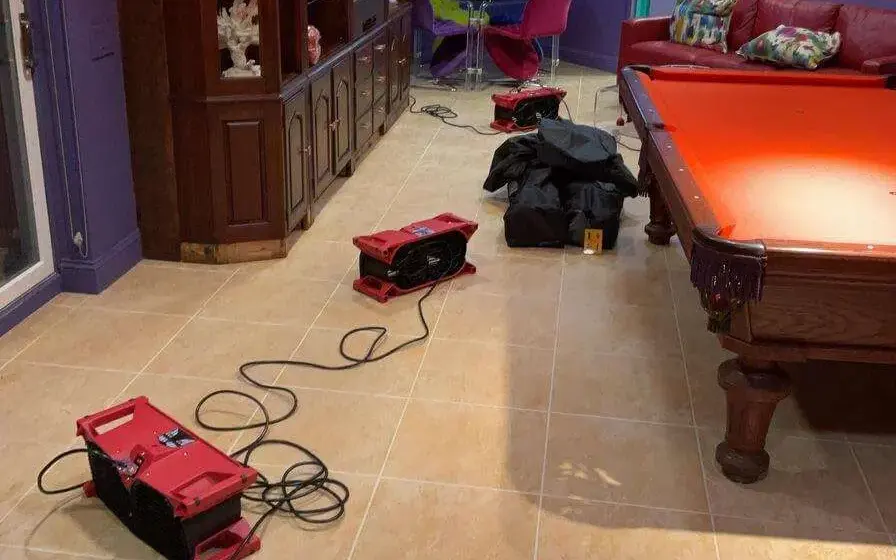
A moisture meter and a thermal camera show how far the wetness has spread. The wall is opened only where the readings call for it, which keeps repair costs down.
Older plaster and wood framing hold water longer than newer drywall. Drying equipment stays in place and the readings are checked again until the framing returns to a dry standard.
This is the part of the work covered by structural drying in Valley Stream, and it is why a quick surface fix without readings is a gamble.
When the leak reaches the basement ceiling
If the stain has dripped into a finished basement, the ceiling and the cavity above it are dried together. Leaving either one wet invites the same trouble to return.
What a finished job looks like
The framing reads dry, the smell is gone and the plumber has replaced the failed section. Rebuilding the wall comes after that, not before.
Who to call and what to expect
The page on cast iron drain leak cleanup in Valley Stream explains how the team traces a stack leak and opens the cavity. Homeowners in the bordering village can read the same service for Lynbrook cast iron drain leaks.
More about the area is on the Lynbrook hub page, since the two villages share a border and a similar housing age.
Questions
How do I know the leak is the drain stack and not a supply pipe?
A supply leak is clean water and tends to show up quickly. A stack leak is drain water, so it usually comes with a smell, brown staining and damage that grows only after the fixtures are used.
Can I keep using the bathroom while I wait?
It is better not to. Every flush or drain adds water to the leaking section and makes the cavity wetter.
Is a drain stack leak covered by insurance?
Coverage depends on the policy and on whether the damage was sudden. Photographs, plumber notes and drying readings make the claim easier to document, and the insurer decides what is covered.
Does the whole wall have to come down?
No. The wall is opened where moisture readings show wet material, and the rest is left in place.
Who fixes the pipe itself?
A plumber replaces the failed section. The restoration team cleans and dries the damaged area around it.