Structural Drying in Lynbrook, NY
Surfaces that feel dry can still hide water in plaster, framing and old hardwood. In Lynbrook houses with a median build year of 1945, the crew dries the structure underneath and backs it up with daily readings.
(888) 527-9860Set up the drying equipment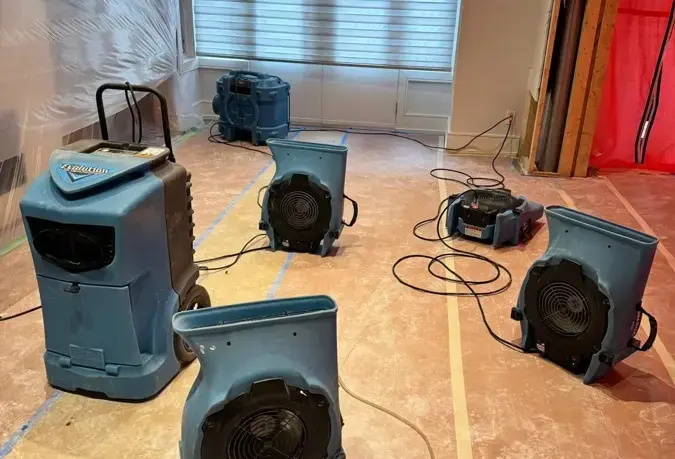 Lynbrook, NY
How structural drying and dehumidification is handled in Lynbrook
The tech who does the walkthrough maps moisture before any equipment goes down, so the drying plan matches what is actually wet. Equipment stays until the readings say dry, not until it looks dry.
- 1
Chart and compare
Wet areas are charted, and a dry sample reading is taken in an untouched room of the house.
- 2
Match the equipment
Each room gets air movers and dehumidifiers that suit its class of loss, placed to sweep the wet surfaces.
- 3
Measure daily
Air and material readings are recorded every day, and the equipment is shifted to follow them.
- 4
Release at dry
The equipment leaves once materials read close to the dry sample.
Fans alone do not finish a water job. Structural drying brings the framing, subfloor, plaster and masonry down to a measured goal, and that measurement is what keeps the damage from returning.
What does structural drying and dehumidification cost in Lynbrook, NY?
In Lynbrook, NY, structural drying typically runs $1,000 to $9,000. The total follows the class of loss, the rooms involved, the materials wet and the days of equipment that the readings call for.
A room or two
- Air movers, LGR unit
- Daily logs
- Short equipment run
A floor or basement
- Added equipment
- Cavity drying
- Psychrometric logs
Plaster, slab, hardwood
- Desiccant dehumidifiers
- Drying mats
- Extended run
Ranges are typical, not a quote: category of water, square footage, material class and how fast drying started move the number most. Run the water damage cost calculator for a closer range.
Why older Lynbrook houses dry slowly
With a median build year of 1945 and 3,358 of 7,507 homes built before 1940, plaster over wood lath, plank subfloors, hardwood and masonry basement walls are all part of the mix. Dense materials release water reluctantly, and a muggy summer slows evaporation further.
- Plaster that soaks up more water than modern wallboard.
- Basement slabs and block walls, the slowest materials to let go.
- Hardwood that cups if it is pushed too fast or left too long.
The drying setup
First comes a moisture map, along with a reading from a dry spot elsewhere in the house to serve as the target. Air movers are aimed across the wet surfaces, and the dehumidifiers are chosen to fit each room's class of loss. Most rooms get LGR units; slab, block and hardwood get desiccant units.
- Daily readings of air temperature, humidity and grains per pound.
- Every wet material is measured against the target each day.
- Units are moved, added or pulled as each area dries.
Knowing when it is done
Equipment is removed when wet materials read close to the dry target, never on a set date, and the daily log is the record an adjuster examines. A rough timeline comes from the drying time estimator, and water extraction comes first when standing water remains.
Structural drying and dehumidification across Lynbrook and nearby villages
The drying team covers ZIP 11563, North and South Lynbrook, from the older houses off Atlantic Avenue and Broadway to apartment buildings near Lynbrook Station and the Westwood LIRR station.
The same service nearby: structural drying and dehumidification in Valley Stream, East Rockaway, Malverne.
Related water damage services in Lynbrook
Structural Drying and Dehumidification questions in Lynbrook, NY
How does the crew decide how much equipment to bring?
The class of loss sets it, a rating of how much water the materials absorbed. Dense plaster, slab and hardwood call for far more drying than a lightly wet carpeted room.
What makes an LGR dehumidifier different?
It removes more water from the air than a household unit, even when humidity is low, and it does most of the work in a typical dry-out. LGR stands for low grain refrigerant.
When do desiccant units come in?
They suit dense materials such as slab, block and hardwood, and cold spaces where refrigerant units lose efficiency.
Why is the equipment so noisy?
Air movers push large volumes of air across wet surfaces. The noise is temporary, and the run usually lasts several days.
Can the equipment be turned off at night?
It is better to leave it running. Drying is continuous, and a pause lets materials reabsorb moisture.
How is dry proven?
By daily readings compared with a dry reference material from the same house. The log goes into the claim file.
Still damp in Lynbrook? Dry it to the readings.
The crew fits equipment to the class of loss and records readings until the goal is met.
(888) 527-9860Structural drying help