Structural Drying and Dehumidification in Cedarhurst, NY
With 992 homes built before 1940 and a median build year of 1953, Cedarhurst has old wood framing and plaster that hold water. The drying team sets equipment to the class of loss and reads the materials every day.
(888) 527-9860Start the drying setup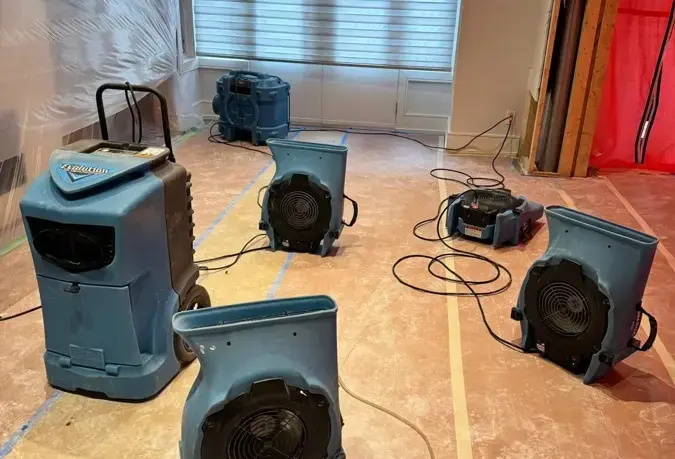 Cedarhurst, NY
How structural drying and dehumidification is handled in Cedarhurst
The tech who does the walkthrough maps moisture before any equipment goes down, so the drying plan matches what is actually wet. Equipment stays until the readings say dry, not until it looks dry.
- 1
Measure the starting point
Meters, thermal imaging and psychrometric readings record how wet each material is.
- 2
Choose the equipment
Air movers, LGR and desiccant units are matched to the class and size of the loss.
- 3
Monitor daily
Readings are taken each day, and machines are moved or added as needed.
- 4
Release the equipment
Units leave only after the materials sit at the dry reference.
A surface can feel dry while the wood behind it is still wet. Structural drying measures what is inside walls, subfloors and masonry, and keeps equipment running until the numbers confirm it, which is why a room can look fine on day one and still fail a reading on day three.
What does structural drying and dehumidification cost in Cedarhurst, NY?
Structural drying in Cedarhurst, NY typically costs $1,000 to $9,000. Expect the total to follow how many rooms are wet, the class of loss and how many days equipment must stay.
One or two rooms
- Fans and LGR units
- Daily logs
- Short run
Floor or basement
- More equipment
- Cavity drying
- Psychrometric logs
Class 4 materials
- Desiccant units
- Hardwood mats
- Extended run
Ranges are typical, not a quote: category of water, square footage, material class and how fast drying started move the number most. Run the water damage cost calculator for a closer range.
Why Cedarhurst buildings dry slowly
Older plaster, wood framing and masonry give water up slowly, and Cedarhurst has 992 homes built before 1940. Dense materials mean dehumidifiers do most of the work, not fans, and humidity from the loss drifts into neighboring rooms, so those are measured too.
- Plaster over lath, which soaks up water and gives it back over several days.
- Hardwood and plank subfloors that cup if dried too fast.
- Block and concrete that need desiccant units.
- Wall cavities behind cabinets and tubs where air does not move.
Setting up the equipment
Psychrometric readings are taken first, then air movers, LGR dehumidifiers and desiccant units are sized to the class of loss. Equipment is repositioned as readings change, so airflow follows the wettest materials instead of staying where it was first set.
- Cavity drying systems reach wall and ceiling bays.
- Hardwood drying mats pull moisture from floors.
- Daily logs track humidity, temperature and material moisture.
Signing off on a dry structure
Equipment leaves only after the materials match a dry reference, never on a timer. See water extraction for what comes before drying, and use the drying time estimator for a rough schedule.
Structural drying and dehumidification across Cedarhurst and nearby villages
The Cedarhurst drying team covers ZIP 11516, from older homes and apartment buildings near Cedarhurst Avenue to the shops on Central Avenue and the blocks around Peninsula Boulevard.
The same service nearby: structural drying and dehumidification in Valley Stream, East Rockaway, Lynbrook.
Related water damage services in Cedarhurst
Structural Drying and Dehumidification questions in Cedarhurst, NY
What is structural drying?
It dries the framing, subfloor, plaster and masonry inside a building, not just the surface, using dehumidifiers and controlled airflow.
How do you know it is dry?
Meters read each material and the numbers are compared against a dry reference. Equipment stays until they match, even when the room feels dry.
Why not just use fans?
Fans move moist air around. Dehumidifiers remove the moisture from the air, so materials can release more.
Can hardwood floors be dried?
Often yes. Drying mats and controlled conditions pull moisture out without cupping the boards, though a few may still need replacing after a long soak.
Does insurance cover drying?
When the loss itself is covered, drying usually is. Check with your own insurer about your policy.
How long does it take?
Three to seven days is typical. The drying time estimator gives a closer estimate.
Still damp in Cedarhurst? Dry it to the readings.
The team sizes equipment to the class of loss and logs readings until the goal is met.
(888) 527-9860Structural drying help